

Intel is finally showing signs of a comeback, but the latest Panther Lake chips quietly reinforce a conclusion Apple reached years ago. Moving to Apple Silicon was the right call.
At CES 2026, Intel unveiled its new Panther Lake lineup for laptops. Early benchmarks look promising for Windows machines, especially compared to older Intel generations. But once you put Panther Lake next to Apple’s M-series, especially the M5 powering the current MacBook Pro, the gap in Apple’s favor is still very real.
The Panther Lake chip everyone is talking about
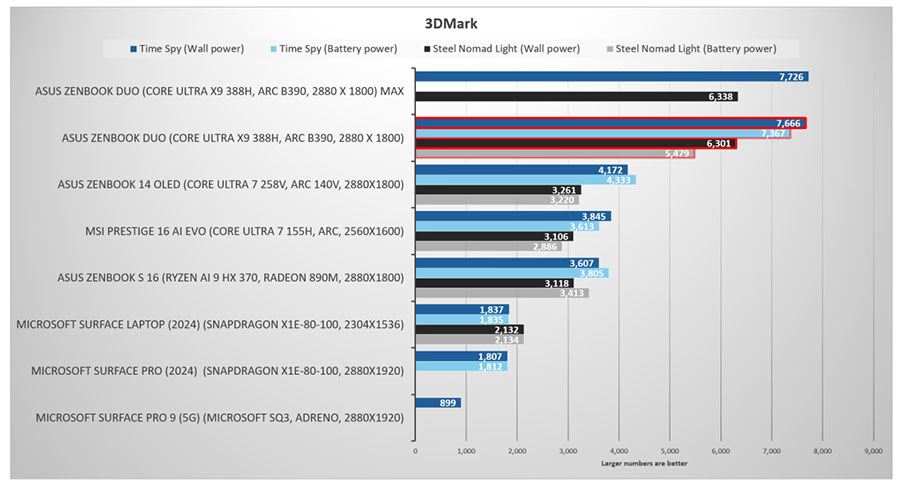
PCWorld tested an Asus ZenBook Duo running Intel’s Core Ultra X9 388H Panther Lake chip. Meanwhile, Luke Larsen at Wired ran benchmarks on two laptops using Intel’s latest Core Ultra Series 3 processors.
This gives us a decent real-world look at how Intel stacks up today.
Related: Apple May Use Intel to Manufacture Future iPhone and Mac Chips
Performance comparison at a glance
When you line up Intel’s Core Ultra X9 388H against Apple’s entry-level M-series chips, here’s what stands out.
CPU performance
- Faster than Apple M4 in some workloads
- Slightly behind the base M5 in multi-core tasks
- Clearly behind M5, M4, and even M3 in single-core performance
Multi-core benchmarks
- Cinebench 24 multi-core
- Intel Core Ultra X9 388H: 1285
- Apple M5: 922
GPU benchmarks
- Geekbench Compute OpenCL favors Intel on Windows
- Apple’s Metal-based scores still dominate on macOS
- M4 Metal score: 57082
- M5 Metal score: 76963
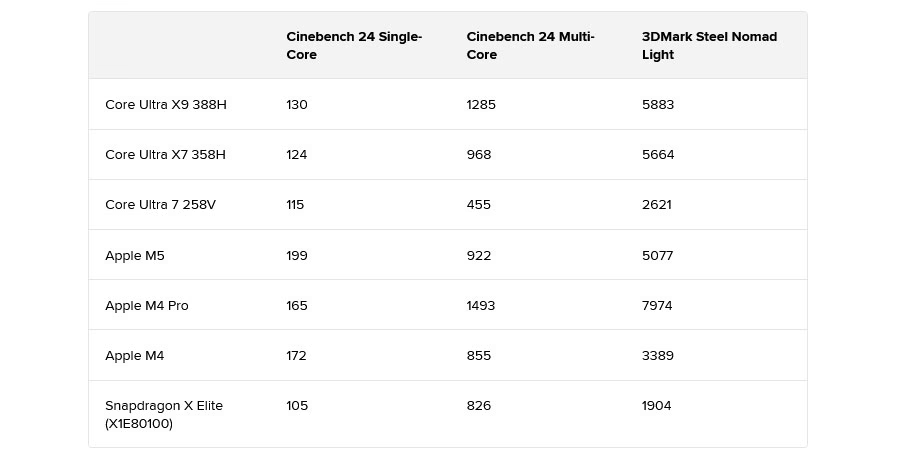
In short, Intel can win specific benchmarks, but Apple still controls the broader performance story.
Worth checking out: M5 Max MacBook Pro Geekbench Scores Could Rival Desktop CPUs
Power efficiency is still Apple’s secret weapon
Raw performance only tells part of the story.
- Intel Core Ultra X9 388H power rating: 25W
- Apple M5 power rating: 15W
- ZenBook Duo battery: 99Wh
- MacBook Pro battery: 72.4Wh
PCWorld measured around 22 hours of battery life on the ZenBook Duo, but noted a performance drop of about 20 percent when running unplugged. Apple’s M-series chips tend to maintain performance more consistently on battery, which matters far more in daily use than headline benchmark wins.
Intel’s win might last a week, not a generation
Wired’s testing shows Intel briefly edging out the M5 in a couple of benchmarks. But context matters.
- Intel loses comfortably to the M4 Pro
- M5 Pro and M5 Max Macs are expected imminently
- Past generational gains suggest M5 Max scores will be far ahead
This makes Intel’s momentary lead feel more like a technical footnote than a real turning point.
The bigger takeaway
Intel’s Panther Lake chips are a genuine improvement and that’s good for competition. But they also underline how far ahead Apple’s silicon roadmap is. Apple didn’t just leave Intel. It left at exactly the right time.


![Can You Easily Repair the MacBook Neo? Teardown Reveals a Surprisingly Repair-Friendly Design [U]](https://404daily.com/wp-content/uploads/2026/03/macbook-neo-easy-to-repair-300x158.webp)