
At nearly $30 per month for its top tier, Netflix is no longer the default streaming subscription it once was.
The latest price increase pushes Netflix firmly into premium territory, and that changes how you evaluate it. It’s no longer about whether Netflix is good. It’s about whether it’s worth keeping alongside everything else.
So, is Netflix still worth it in 2026? The answer depends less on Netflix itself, and more on how it compares to the rest of the streaming market.
What Netflix costs now, and why it matters
Netflix’s current pricing structure looks like this:
- Standard with ads: $8.99/month
- Standard (no ads): $19.99/month
- Premium (4K): $26.99/month
The key shift here is psychological as much as financial.
The moment a streaming service approaches $30/month, it stops being an impulse subscription and starts competing with your entire streaming budget.
That’s where Netflix’s value proposition begins to get tested.
How Netflix compares to other streaming services in 2026
Netflix is no longer competing in a vacuum. It’s competing against a market that has matured, diversified, and, in some cases, become more strategic about pricing.
Disney+: franchise + bundle value
- With ads: $11.99/month
- Ad-free: $15.99/month
Disney+ leans heavily on major IP like Marvel, Star Wars, and Pixar. It’s typically cheaper than Netflix and often bundled with other services like Hulu/ESPN+ in some regions, which increases its perceived value.
The trade-off is depth. You get strong, recognizable content, but not the same breadth or constant release cycle as Netflix.
Amazon Prime Video: bundled advantage
- Included with Prime ($14.99/month in the US)
- Standalone: $8.99/month (with ads in some regions)
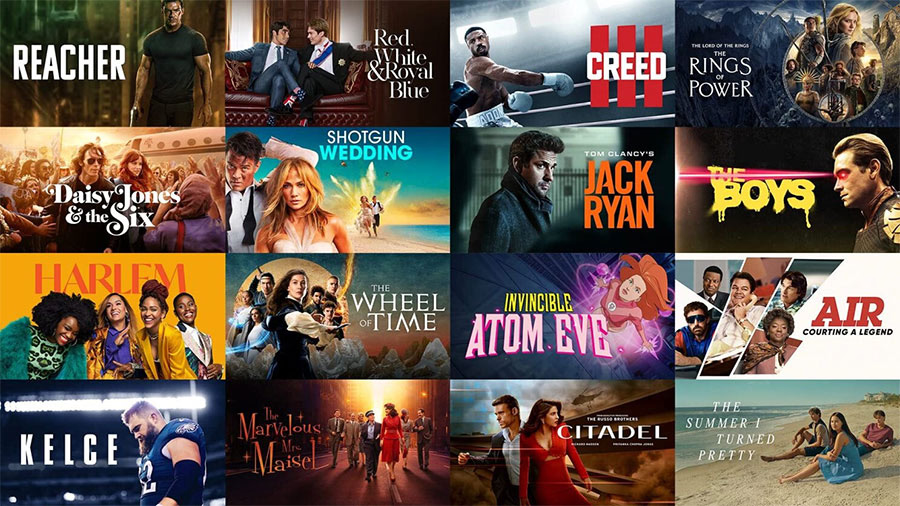
Prime Video is rarely judged as a standalone service because it’s included with Amazon Prime.
That changes the value equation entirely. Even if you don’t watch Prime Video often, it feels “free” within a broader subscription, which makes it easier to justify than Netflix’s standalone cost.
Apple TV: quality over quantity
- Single plan: $12.99/month (ad-free, 4K included)
Apple TV takes a completely different approach.
Its library is smaller, but it focuses heavily on high-quality originals. It’s also significantly cheaper than Netflix, which makes it an easy secondary subscription rather than a primary one.
In terms of value, Apple TV+ isn’t trying to replace Netflix. It complements it at a much lower cost.
Where Netflix still wins
Despite the competition, Netflix still has clear advantages.
It offers the widest range of content across genres, regions, and formats. Its release cadence is faster, and it consistently delivers new shows, films, and global hits that keep users engaged.
For users who spend a lot of time watching content, this matters more than pricing alone.
There’s also the familiarity factor. Netflix’s interface, recommendation system, and overall experience remain among the best in the industry.
If Netflix is your primary streaming platform, the cost per hour of entertainment can still justify the price.
Where Netflix starts to lose value
The cracks start to show when Netflix is no longer your main platform.
If you’re subscribed to multiple services, Netflix becomes the most expensive line item without offering a proportional increase in value.
It also struggles to justify its Premium tier for many users. Paying $26.99 only makes sense if you actively use 4K streaming and multiple screens. Otherwise, you’re paying for features that don’t materially improve your experience.
This is why search intent is shifting toward questions like:
- is Netflix Premium worth $26.99 in 2026
- Netflix vs Apple TV+ which is better value
- should I cancel Netflix subscription
The real shift: from default to optional
Netflix used to be the baseline. Now it’s becoming optional.
That’s a fundamental change.
Instead of being the one service you always keep, Netflix is now something you evaluate month to month. Meanwhile, cheaper or bundled services fill in the gaps more efficiently.
This doesn’t mean Netflix is worse. It means the market around it has become more competitive and more strategic.
A smarter way to use Netflix in 2026
Power users are adapting with a simple strategy: rotation.
Subscribe to Netflix when there’s something worth watching, then cancel and switch to another platform. This approach maximizes value without committing to a constant high monthly cost.
It also reflects how content is now distributed across platforms rather than concentrated in one place.
The 404 take
Netflix is still one of the best streaming services available. That hasn’t changed.
What has changed is the price, and the expectations that come with it.
At $26.99/month, Netflix is worth it if you use it heavily and rely on it as your main source of entertainment. But compared to services like Disney+, Prime Video, and Apple TV+, it’s no longer the obvious choice.
In 2026, Netflix isn’t a default subscription anymore. It’s a premium one that needs to justify its place in your lineup.