

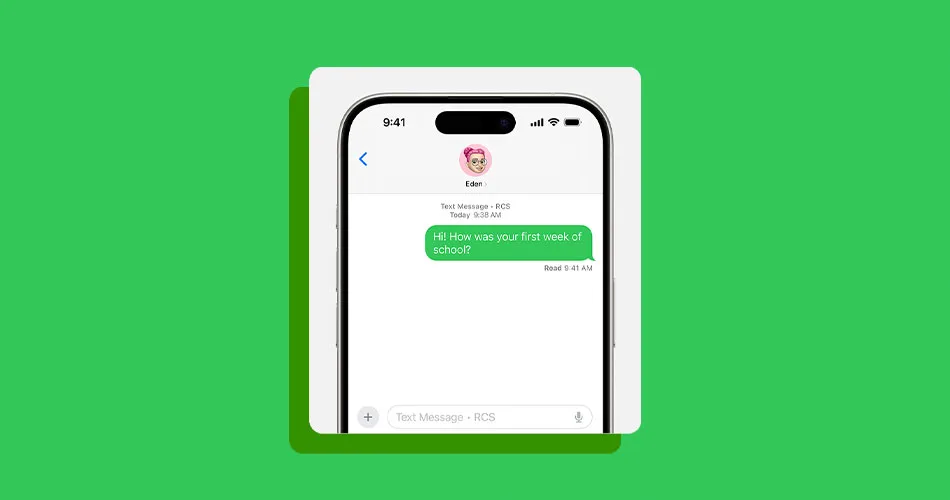
New findings in iOS 26.3 beta 2 suggest that end-to-end encryption (E2EE) for RCS messages is actively being prepared, nearly a year after Apple first confirmed plans to support it.
The update does not enable encrypted RCS outright, but it introduces the clearest technical signal yet that Apple is laying the groundwork for a broader rollout.
A Quiet Change With Big Implications
The discovery comes from code references spotted by Tiino-X83, which point to a new carrier bundle setting inside iOS 26.3 beta 2. This setting would allow mobile carriers to enable or disable end-to-end encryption for RCS messaging at the network level.
That detail matters. Unlike iMessage, which Apple fully controls, RCS sits at the intersection of Apple, carriers, and global standards. Encryption, while encouraged, is not universally mandated in every market.
Interestingly, the code appears to be limited to four major French carriers, Bouygues, Orange, SFR, and Free. No other carriers across other regions were found to include the same configuration, suggesting Apple may be testing compliance paths in specific regulatory environments before expanding further.
Why Carriers Are Involved at All
The behavior aligns closely with GSMA’s RCS specifications, which clearly define how encryption should work across markets. According to the standard, RCS clients are expected to enable E2EE by default, except where local laws explicitly prohibit it.
As the documentation states:
“RCS clients shall enable E2EE by default unless expressly prohibited by local regulations.”
The GSMA also makes it clear that encryption decisions must apply to entire markets, not individual users. In other words, Apple cannot selectively enable encrypted RCS for some users on a carrier while excluding others. It is all or nothing.
This explains why Apple appears to be relying on carrier bundle switches rather than user-facing toggles. If encryption is disabled, users must be notified that E2EE is unavailable in their region.
Visibility and Transparency Requirements
Another notable requirement in the GSMA standard is user visibility. When RCS messages are end-to-end encrypted, users must be able to see that encryption is active. This mirrors what Apple already does with iMessage, where encryption is assumed but still part of Apple’s broader privacy messaging.
The newly discovered carrier setting could be Apple’s way of ensuring it meets these obligations while staying compliant with regional rules.
Will Encrypted RCS Launch in iOS 26.3?
At this stage, nothing is guaranteed. Apple could be laying technical foundations for a later iOS release, rather than flipping the switch in 26.3 itself. The company has a long history of seeding features quietly before activating them months later.
That said, the presence of carrier-specific logic suggests this is more than speculative groundwork. Apple typically does not add market-level controls unless a feature is approaching readiness.
Why This Matters
Encrypted RCS would significantly improve privacy for conversations between iPhone and Android users, closing a long-criticized gap where messages lacked the protections users now expect by default.
If and when it ships, it would also mark another step in Apple’s gradual embrace of modern messaging standards, on Apple’s terms.
For now, iOS 26.3 beta 2 does not deliver encrypted RCS. But for the first time, it strongly suggests that Apple is no longer just talking about it. It is actively preparing for it.


![Can You Easily Repair the MacBook Neo? Teardown Reveals a Surprisingly Repair-Friendly Design [U]](https://404daily.com/wp-content/uploads/2026/03/macbook-neo-easy-to-repair-300x158.webp)