
Apple just did the most Apple thing possible again. For the 19th straight year, the company has landed at the very top of Fortune’s World’s Most Admired Companies list for 2026. Nineteen years. At this point, it is less a winning streak and more a permanent reservation.
Nineteen years, zero flukes
Fortune’s ranking is not a popularity contest driven by fans or hype cycles. It is based on surveys of roughly 3,000 executives, directors, and analysts who rate companies within their own industries. The criteria go well beyond flashy products and include management quality, use of capital, social responsibility, and the ability to attract and retain talent.
That context matters, because Apple’s continued dominance comes during a year when AI anxiety is at an all-time high. While critics often frame Apple as “behind” in the AI race, the people running companies appear to value something else just as much: consistency, discipline, and execution at scale.
Why Apple still wins, even in the AI era
Fortune summed it up bluntly. While Apple watchers may fret about AI, survey respondents continue to reward Apple for how it manages talent, supply chains, and capital. Innovation matters, but so does not breaking everything else while chasing it.
Suggested: iPhone Overtakes Samsung in Global Market Share as Apple Pulls Ahead in 2025
AI still left its fingerprints all over this year’s list. Nvidia landed at number four, while AI-fueled climbers like AMD and Workday cracked the top 50 for the first time. Even so, Apple’s ability to operate smoothly across hardware, software, and global logistics appears to carry just as much weight as shipping the flashiest new model.
In other words, Apple is still winning the boring but incredibly hard parts of running a trillion-dollar company.
A familiar top 10, with minor reshuffling
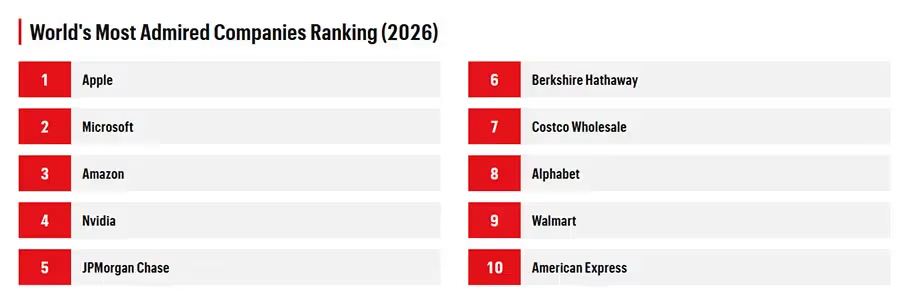
The top 10 list itself looks reassuringly stable, with no dramatic shakeups or surprise newcomers:
- Apple
- Microsoft
- Amazon
- Nvidia
- JPMorgan Chase
- Berkshire Hathaway
- Costco Wholesale
- Alphabet
- Walmart
- American Express
Compared to last year, JPMorgan Chase climbed two spots, while Walmart edged past Alphabet. The broader takeaway is not who moved where, but how entrenched these names have become. These are institutions now, not just companies riding short-term momentum.
Tech movers outside the spotlight
Outside the top 10, there were some notable shifts worth watching. Netflix jumped three spots to number 12, IBM climbed an impressive 11 places to number 32, and TSMC gained nine spots to land at number 36. On the flip side, Salesforce slipped to number 20, Accenture fell to 33, and Samsung Electronics dropped 12 spots to number 37.
None of these moves dethrone Apple, but they do highlight how competitive the tech sector remains once you look past the very top.
The bigger picture
Apple’s 19-year run at number one is not about a single product cycle or a single technology trend. It reflects long-term trust in how the company is run. Even as AI reshapes industries and rewrites expectations, Apple continues to be admired for stability, execution, and restraint.
That may not always make for the loudest headlines, but for nearly two decades, it has been enough to keep Apple exactly where it is now: at the top.


![Can You Easily Repair the MacBook Neo? Teardown Reveals a Surprisingly Repair-Friendly Design [U]](https://404daily.com/wp-content/uploads/2026/03/macbook-neo-easy-to-repair-300x158.webp)